
Media:
Shattered Lands – what a book!
Thursday, 11 December 2025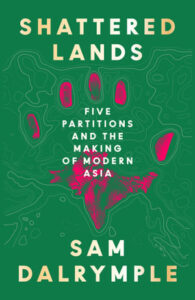 Sam Dalrymple, still in his ‘20s, is the son of well-known writer William Dalrymple, and Shattered Lands: Five Partitions & the Making of Modern Asia is easily the most interesting historic – through to current events – title I’ve read this year. I’m also surprised nobody has looked at this fascinating topic in one book before. Before WW II the British Indian Empire – the Raj – stretched from the Red Sea (starting with the Aden Protectorates, now the southern half of Yemen) all the way east to Burma/Myanmar, ending with the border with Thailand. I’m a little puzzled that Nepal creeps into this geographic sweep, but I’m equally surprised that Sri Lanka doesn’t.
.
Then bit by bit, although mostly with Indian independence and the simultaneous ‘partition’ of India and Pakistan, the whole thing shattered.
.
What was once upon a time simply the Indian Empire is now Yemen, Oman, UAE, Qatar, Bahrain, Kuwait, Pakistan, India, Nepal, Bhutan, Bangladesh and Myanmar. And independence certainly has not been unanimously a good thing, there were huge number of lives lost at almost every step along the way, international relations between what was formerly a unified whole are often bitter and economic changes have often been backwards.
.
If somebody from Lahore (now in Pakistan) wants to meet with associates from Delhi (in India) and Dhaka (in Bangladesh) under British rule, ie before independence in 1948, politically it would have been no trouble. Today they probably should be scheduling their meeting for London. Or Dubai. Getting visas for each other’s countries is near impossible and transport? Delhi-Lahore is just over 400km, so a 45minute flight? No way, better allow 10 hours to travel between these two important cities. Unbelievably there are no direct flights between India and Pakistan, you can travel via Thailand, Sri Lanka or Dubai. Travel by land and the entire 3000+ km India-Pakistan border has only one crossing point!
.
It’s remarkable how almost nobody comes out looking very good from this break up. The British Lord Mountbatten who oversaw Partition? He did a rush job to get it done with all sorts of long-term problems as a result. Plus he was far more enthusiastic about how he was going to look in the photographs than he ever was about doing a good job. The wonderful Mahatma Gandhi? Well he probably crashed any possibility of creating a post-partition Muslim-Hindu nation more comprehensively than Muhammad Ali Jinnah did, even though it’s Jinnah who usually gets the blame. Jawaharlal Nehru? He may have loved Kashmir nearly as much as he loved Edwina Mountbatten, so he can shoulder some of the blame for Kashmir being an ongoing disaster zone for India-Pakistan relations.
.
So it’s reassuring to find the odd little bit of ‘good sense’ in amongst all the blundering disasters. Gilgit and Hunza are regions of Kashmir, north of the familiar Kashmir Valley and confusingly separate from the rest of Kashmir. As everything was going wrong with partition Gilgit was under the control of the Gilgit Scouts commanded by William Brown, Scottish and 24 years of age. As he saw it all of Kashmir should be going to Pakistan, since the population was predominantly Muslim. He couldn’t do anything about the main part of Kashmir, further south, but he did decide to hand over Gilgit to Pakistan. Which he did with remarkably little fuss and in remarkably good order. There were no chaotic lashkar tribesmen trying to grab Gilgit, as they had unsuccessfully and bloodily tried to do with the rest of Kashmir. Maureen and I went through Gilgit, twice, on our way up the Karakoram Highway through Pakistan to China in 2012. I’d have investigated William Brown if I’d known about him when we were there. Click here for the first part of our Karakoram Highway travels.
.
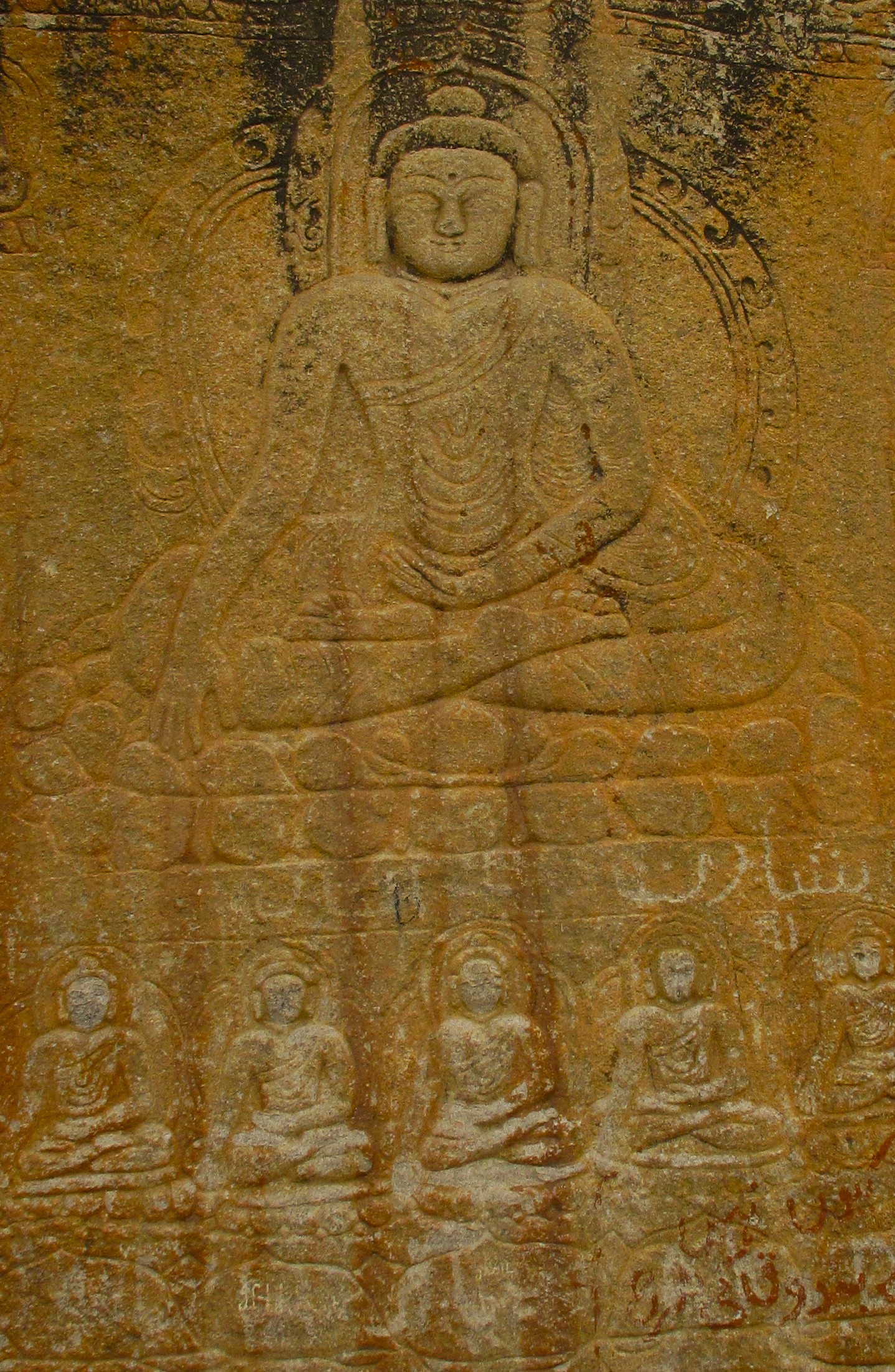 ◄ At several points along the Karakoram Highway we encountered superb petroglyphs – Buddhist ones, nothing Hindu or Muslim about them. These Buddha images were at Skardu, off the Karakoram Highway, but in Gilgit-Baltistan.
.
Then during the horrific split of the two Pakistans, East and West, and creation of Bangladesh in 1971 Archer Blood, the American Consul General in Dhaka, did everything he could to alert the world to the bloodshed and beg Washington DC to step in. Unfortunately, just as Taco Trump today is easily sucked in by stronger leaders, ie he’s keen to lick Putin’s boots, so did Richard Nixon and Henry Kissinger fall for Pakistan’s leader Yahya Khan. No way were they going to support Bangladesh even if, as Blood, suggested the situation in Dhaka was so bad that ‘unfortunately, the overworked term genocide is applicable.’
.
The angry message to Washington was the first example of what came to be known as a ‘Dissent Cable’ and although it crashed Blood’s diplomatic career he is today seen as something of a hero of foreign relations, particularly in Bangladesh.
.
The British ‘Indian Empire,’ ‘The Raj,’ before it shattered, was mainly India of course. But there was also the far less important Arabian Raj, which once upon a time was just something tagged on to India and indeed run from India. Today the Arabian Raj has become Yemen, Oman, UAE (United Arab Emirates), Qatar, Bahrain and Kuwait. The western part of modern Yemen was always Yemen, the eastern part was the Aden Protectorate not technically part of the Arabian Raj.
.
The British departure from India in 1948 and the badly managed partition of India and Pakistan was done in great haste because Britain, close to bankruptcy after WW II, simply wanted to wash their colonial hands of their India problem. Soon they were looking at the Arabian Raj from a similar perspective and the first ‘country’ to depart the Arabian corner of the British Empire was Kuwait in 1961. Bahrain, Qatar, the Trucial States (soon to become the United Arab Emirates) followed in 1971. The British had to get rid of Sultan Said (‘feudal, reactionary and isolationist’ according to Wikipedia) in 1970 before they could install Sultan Qaboos in his place and grant Oman (formerly Muscat & Oman) its independence. One of the immediate changes was the ending of slavery, which continued right up until 1970. Sultan Said may have been enthusiastic about slavery, but he disliked schools, roads and most other modern inventions.
.
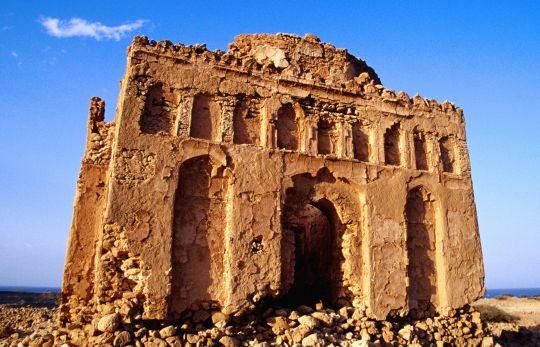 ▲ I’ve been to Oman several times over the years, this is the Tomb of Bibi Miriam in Qalhat. Marco Polo (13th century) and the great Moroccan traveller Ibn Batuta (14th century) both stopped by.
.
And then there’s Yemen. The Aden Protectorate was always a major problem and finally the British departed in 1967. Effectively they handed over South Yemen to the NLF (National Liberation Front), but in fact the NLF put as much energy into fighting with FLOSY (Front for the Liberation of Occupied South Yemen) as they did with the British and that continued after the British departure. Meanwhile North Yemen emerged from the collapse of the Ottoman Empire in WW I as the Kingdom of Yemen and then became the Yemen Arab Republic from 1962. Effectively Yemen has always been in turmoil and uniting North and South Yemen into the Republic of Yemen in 1990 has not made much difference.
.
It’s interesting to contemplate that all of the Arabian Raj could have gone in the same direction, instead the region today is a neat division between the hyper-wealthy Arab states along the Arabian/Persian Gulf and hyper-chaotic Yemen with Oman acting, perhaps, as a buffer zone between the two regions. Dalrymple comments, in his book’s Epilogue, that the countries of the old Arabian Raj have undergone an ‘unimaginable class reversal’. During the Empire days the region was ruled from India, the Arab citizens were subservient to Indian government officials. Today there may be Indian businessmen and Indian technicians in the Gulf states, but overwhelmingly the great mass of the Indian population is at the bottom of the social scale: cheap labour.


