Places:
Orkney Islands – Part 2
Tuesday, 5 May 2026Part 1 covered Mainland, the largest island of the Orkney group with the ‘capital’ Kirkwall and the arrival point for many visitors Stromness. Plus the islands of Lamb Holm, Burray and South Ronaldsay, linked to Mainland by the causeways across the Churchill Barriers, built during WW II to stop German U-boats sneaking in to Scapa Flow.
.
Now I take the 0720 morning ferry on the 1-1/2 hour trip to Westray, docking at Rapness at the southern end of the island. I must have fallen asleep at some point after we leave as the next thing I know we’re arriving at Westray Island. Andy and Karen of Westraak pick me up and we drive into Pierowall and stop by their house for a breakfast scone and then head off on a very busy day.
.
Starting with a drive up to the northern tip of the island, just west of the airport, for a look at the Natural Arch and pondering if you can even kayak through the arch, if the seas were calm. Just beyond the arch is a narrow, steep-sided, inlet – a geo is the local term – where around 1730 a ship was driven ashore with a small boy the only survivor. Since the ship was from Archangel in Russia – or perhaps even named Archangel – he became Archie Angel, grew up to marry a local girl and establish the family name Angel, although it now appears to have died out?
.
We drive south to Quoygrew, a Norse settlement which might be a thousand years old. Nearby is a house which takes its design inspirations from the same Norse starting point, ie it’s long and narrow, leading back from the waterfront. There are also a series of nousts, boat-shaped notches where vessels could be drawn up out of reach of storm waters or stored there through the winter months.
.
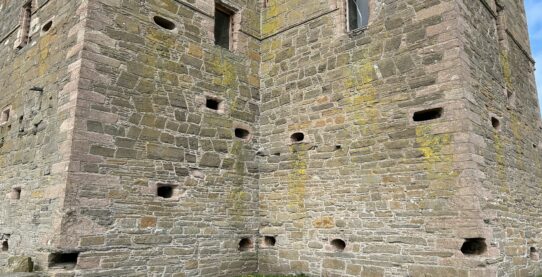 ▲ Nortland Castle, overlooking Pierowall, was built around 1560 – well half-built, it was never finished – by Gilbert Balfour, master of Mary Queen of Scots’ household, and a man needing a strong fortress since he seemed to have had no shortage of enemies. Hence the 71 gun holes for taking potshots at any enemy intruders. There’s also a really magnificent spiral staircase.
.
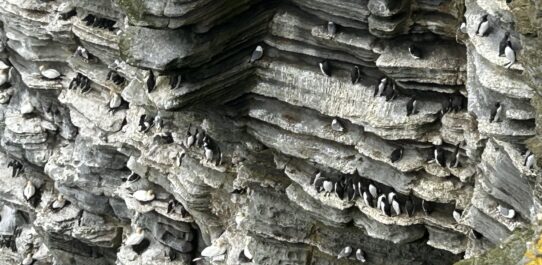 ▲ Gannets and guillemots on a cliff face below Noup Head
.
After a big lunch – soup, fish, bread – we spent the afternoon walking out to the island’s north-western promontory, Noup Head with its fine Stevenson lighthouse. We follow the steep cliff edge on our way back looking down on level after level of nesting birds, gannets, shags, guillemots all at their appropriate levels. No puffins yet, they’re still to arrive. We pass one geo with the Gentleman’s Cave, which supposedly you could get to, once upon a time, but everybody talks about its inaccessibility today and nobody has been there?
.
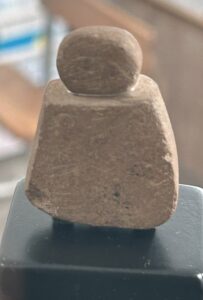 ◄ The Westray Wifie – So back to Pierowall and a look at the Westray Heritage Centre with the tiny four-cm-high image of the Westray Wife (or Westray Wifie or Orkney Venus). ‘This Neolithic sandstone figurine discovered at the Links of Noltland in 2009 is the earliest Neolithic human carving found in Scotland and the oldest face found in the UK.’ There are assorted other interesting exhibits including a ‘cliff face’ with guillemots and puffins. Outside there’s a whale skeleton and a boat in a noust.
.
.
.
.
.
.
.
.
.
.
 ◄ An Orkney A to Z – Jerry Wood’s Ruminations of a drystone dyker And other dreams – £20 and I recommend it.
.
I spend the night at Jerry Wood’s B&B 1 Broughton Place in Pierowall, he’s a real character – sheep wrangler, painter, poet and the island’s best ‘drystone dyker,’ which is to say he constructs drystone walls. Some of the island’s explanatory signboards are mounted on Jerry’s drystone plinths. I chat with Jerry before I walk round to the Pierowall Hotel for dinner.
.
.
.
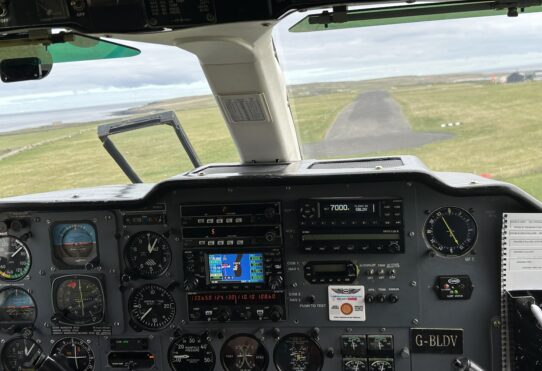 ▲ Approaching Papa Westray Airport – for airline nerds the Westray-Papa Westray flight is a not-to-be-missed experience: the world’s shortest scheduled flight. They pointed out from the Westray Airport that you could see the Papa Westray runway across the narrow strait between the two islands. I set my stopwatch as the Loganair Islander started its takeoff run. Two minutes later, perhaps it was less, we were back on the ground.
.
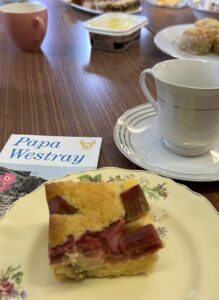 ◄ Don’t miss the Wednesday morning coffee and cake gathering at the parish hall in Beltane, the Papa Westray ‘centre,’ I was told. Well there’s a shop, a school and a post office as well as the church and parish hall. There are about 20 islanders there, which means about a quarter of the island’s population of 80! I indulge in a slice of rhubarb cake, rhubarb, I’m told, is the one thing that grows readily on the islands
.
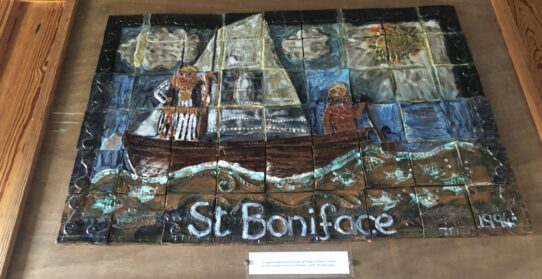 ▲ St Boniface Church, Papa Westray
.
I had four hours between my arrival on Papa Westray and my departure for Kirkwall on Mainland. Time for a stroll north along the east coast – beach, headland, beach, headland – from the kelp store near Beltane. Then I cut across the island, north of the airport, to St Boniface Church, the original church dates from the 12th century. From the church I turn south down the west coast to Knap Howar – ‘a Neolithic farmstead which may be the oldest preserved stone house in northern Europe.’ Even older than Skara Brae? I turn east again past Holland House farm and on to the airport.
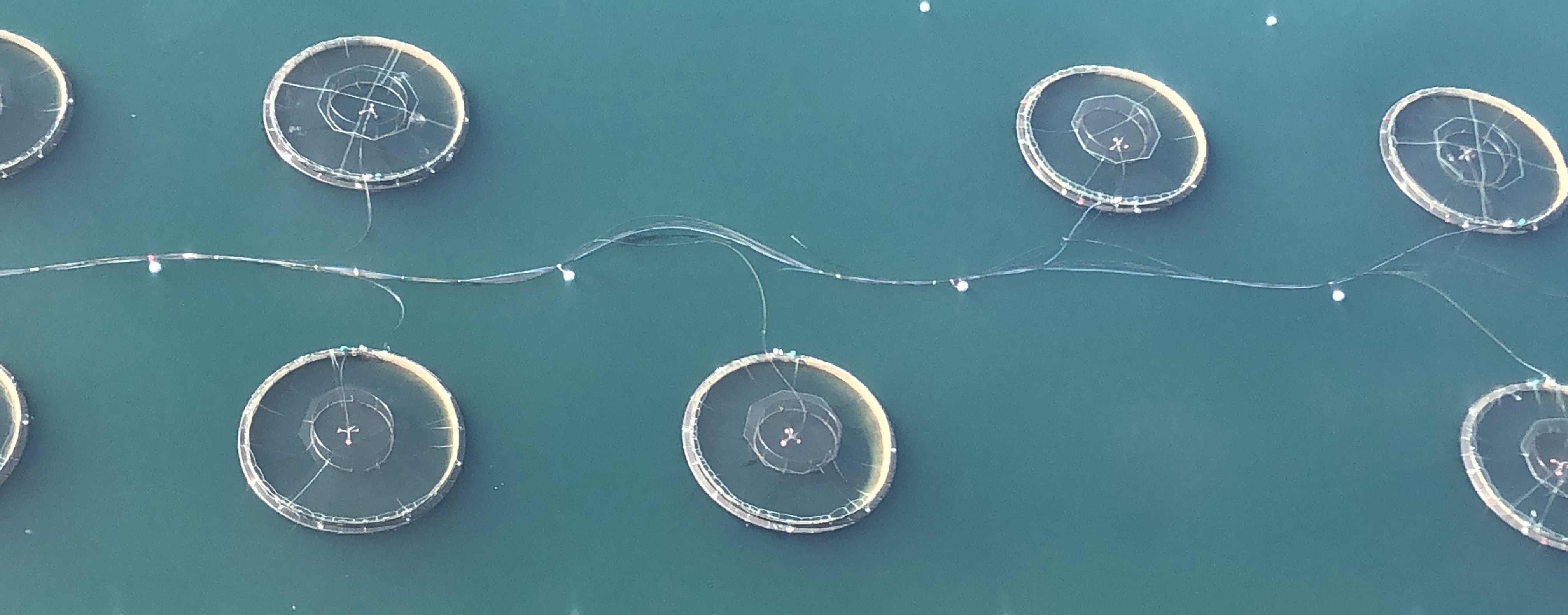
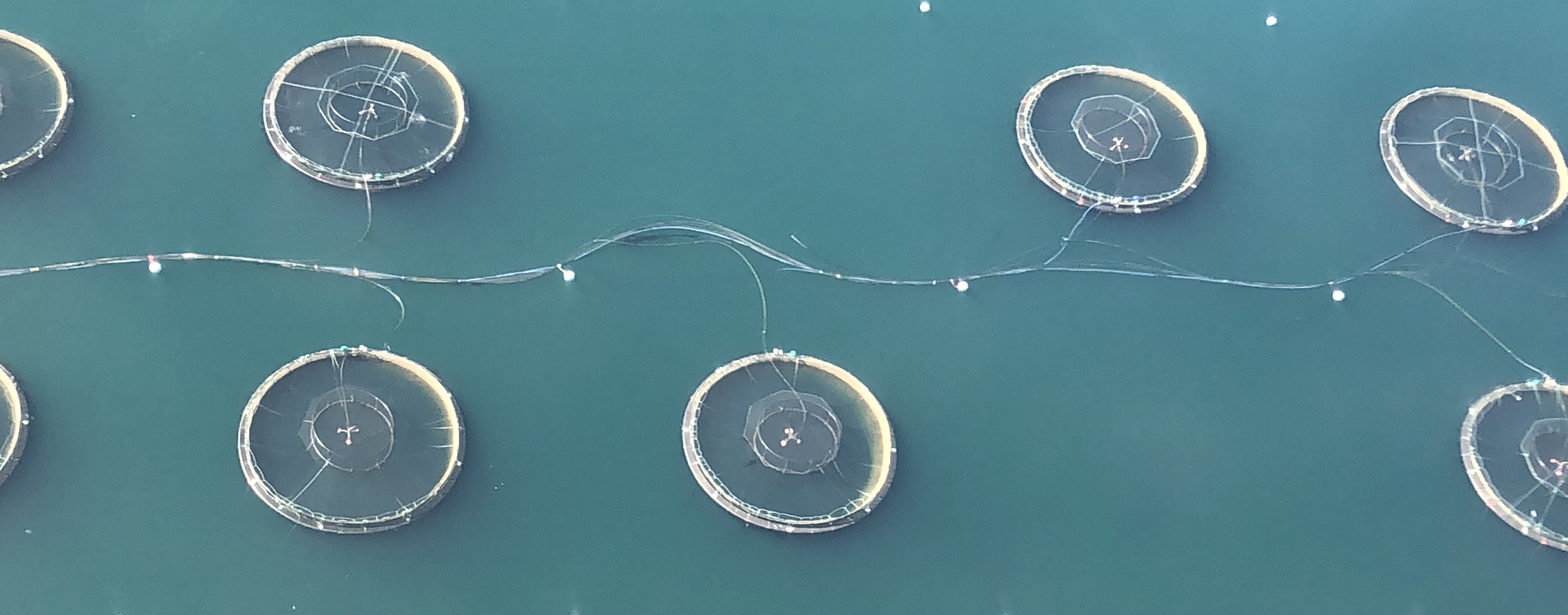
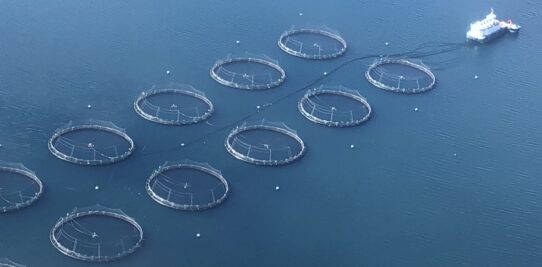 ▲ It takes just 15 minutes to fly back to Kirkwall from Papa Westray and en route we pass over assorted salmon farms, it’s a big business in the Orkney Islands. And the most featured fish you find at Orkney restaurants
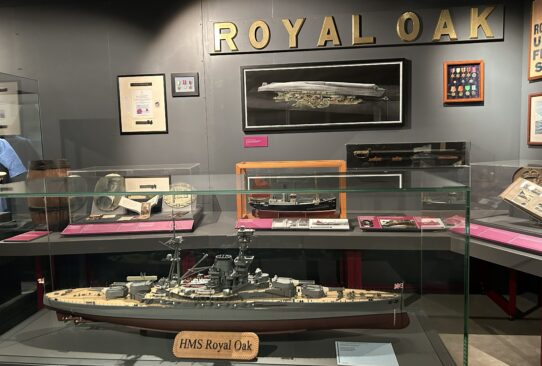 ▲ HMS Royal Oak, Scapa Flow Museum
.
I take the ferry, not much over half an hour, from Houton on Mainland to Lyness on Hoy to visit the excellent Scapa Flow Museum.
.
Scapa Flow was a British Royal Navy base through both World Wars, finally closing in 1956 And the site for assorted naval disasters. HMS Hampshire (1903), a Devonshire-class armoured cruiser of the Royal Navy, departing Scapa Flow on 5 June 2016, heading to Russia for meetings with the Czar, hit a German mine in terrible weather and went down with only 12 survivors out of the total of almost 800 on board. Lord Kitchener, hero of Sudan, biggest name in the British army, was among those lost. On 9 July 1917 the dreadnought battleship HMS Vanguard blew up without any enemy help, only two survivors out of 845 crew. Then on 14 October 1939, WW II barely underway, the German submarine U-47 sneaked into Scapa Flow with great skill and sent HMS Royal Oak to the bottom, 835 of the 1234 crew members died. Not good odds being on a British battleship?
.
The other big Scapa Flow moment came after WW I when 74 ships of the German fleet were penned up there while decisions were made on what to do with them. Their German commander sorted that one out when he signalled to his fleet and the whole lot were scuttled, sent to the bottom, or beached. Today scuba diving the German fleet is a big attraction, but in fact there are only a handful of them left. Between 1922 and 1930 almost all of them were salvaged, an operation requiring amazing ingenuity and sometimes quite a serious risk to the divers and other underwater workers involved. The 26,000 ton Hindenburg was the final and most challenging operation although some salvaging went on after WW II right up to 1979. Only seven German vessels remain on the bottom. Diving Scapa Flow? Reasonable depth, 12 to 45 metres, so some of it is for serious divers, but there are also some tricky currents and bloody cold water by my books, 6 to 14℃.
.
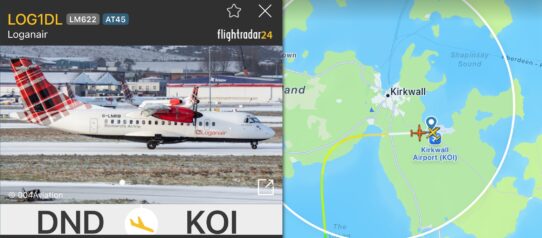 ▲ It took me almost 24 hours to travel London to Orkney – train train train ferry – concluding in Stromness. Flying back with the Scottish airline Loganair – Kirkwall-Dundee-London Heathrow – is much faster. But where’s my plane? Almost here, it was delayed departing Dundee on its way north.


