The Meaning of Life – and my contribution
Thursday, 18 December 2025In 1930, philosopher Will Durant met a man who said he was about to commit suicide unless someone gave him a good reason not to do so. This inspired Durant to contact 100 people involved in the arts, politics, religion and sciences to write what they felt life was all about. The end result was On the Meaning of Life, a book which was not a big hit, it did much better when it was republished in 2005.
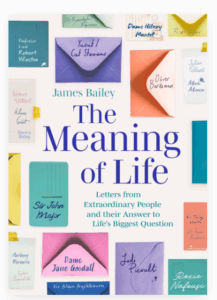 Much more recently – and from the UK rather than the USA, click here for The Guardian’s review – James Bailey replicated the project with The Meaning of Life and I’m one of the people he approached to reveal what life was all about from their perspective. In fact I was a bit disappointed by the end result: lots of people decide life is all about ‘love, being happy, doing good, etc etc.’ Assorted people fall back on religion – Islam, Christianity, Judaism – they know it’s all about following their religious beliefs, underlining yet again why I have so badly gone off religions in recent years. Jimmy Carter is in there, suggesting we should just follow ‘the perfect example set by Jesus Christ.’ Although I did rather like Pico Iyer’s suggestion that for him it’s been all about frequent silent retreats. Fine for you Pico!
Then there’s a little spate of people living lives which have been seriously disrupted by major damage – a women horribly injured by the London public transport terrorist bombings, somebody else horribly injured during the Falklands War and a poor woman horribly attacked by her horrible husband. And she was eight months pregnant. What a world I began to think?
On the other hand I did like Claire Williams – Williams Formula 1 team manager – quoting her father Frank ‘Aren’t we just the luckiest people alive, Claire? We get to do this. Everyday. And we get paid for it.’ From his wheelchair, although the book doesn’t reveal that. Dave Fishwick, he started a bank from nothing, dispenses assorted good thoughts and advice. And Dame Stephanie Shirley probably sums up the ‘do good things’ ideal with ‘I share with the great Rousseau the belief that ‘the meaning of life is a life of meaning’.’
Bob Geldof’s contribution doesn’t feature, perhaps because he wrote ‘five words, and three of them were ‘no’! Explorer Sir Ranulph Fiennes tops the pointless answers category – the meaning of life for him is for you to buy his book ‘obtainable via Kindle or Amazon or eBay.’ Oh get a life Sir Ranulph! Never mind, over 100 people came up with their views and, for what it’s worth, here’s the meaning of my life, as it appears in The Meaning of Life:
It’s a little late for me to try and do something really useful now, I have to live with what my life has been, I’m not going to make any big changes – now – in the years I have left. Next lifetime, well I’ll do things differently, starting with putting more effort into languages. OK I can ask for a cold beer – cerveza fría – bir dingin – kaltes bier – in a surprising number of languages, but after that my linguistic abilities rapidly fade. But even in that next lifetime I don’t see myself doing anything wonderful politically, socially, culturally, so I’ll just have to live with what my life has been and still is. And that comes down to one word ‘travel.’
At this end of my life, in our much battered world as it is today, saying that travel is what your life has been all about has to immediately be defended – what about climate change, overtourism, all those terrible negative effects of travel? Shouldn’t I just be retreating indoors, shutting the door, going nowhere and in that way making a tiny baby step towards righting all the damage I’ve done in my lifetime? Sure I could, or I could put the next thousand words into defending the positive side of travel, that it’s how we meet the world, that it employs so many people, that it’s not any worse than lots of other ways we can damage our environment from addiction to fast fashion to mining crypto-currencies. So I am not going to bother.
The simple reality has been that my working life has been all about travel and even now, well past the end of my working life and sliding down what is clearly going to be my final years, travel is what I love most. In fact my travel addiction started even before my working years, as a child the whole idea of going somewhere, seeing places, clearly had a fascination whether it was collecting stamps, drawing maps or even asking for a globe as a Christmas present. Then in my late school years, at university, I started travelling and not much later I found a way to turn an attraction into an occupation and a lifetime story: Lonely Planet.
That very first guidebook, an amateurish affair exactly 50 years old as I write this, was an accident. I didn’t set out on the hippie trail – the Asia overland route as we defined it at the time – intending to make a career out of it. Lots of other young people, baby boomers like me, were doing the same trip and to be quite honest many of them made a far better job of it than I did. They travelled further, longer, more adventurously, with more understanding, than I ever did. Tough luck, they didn’t make a generational pursuit out of their great trip, I did.
Fifty years after that very first guidebook it’s hardly surprising that I’m regularly being asked to look back at what we helped to create, because from the very start it was two of us, my wife Maureen and I, not a solo endeavour. And I am proud of it, as I’ve already confessed travel is not an unmitigated good, there are considerable downsides, but overall I think the travel revolution that has taken place during my lifetime has been a wonderful force for good. It’s not only ‘us’ going out into the world and meeting ‘them’ it has also been the other way around, the world bouncing back to engage with us.
I’ve seen that in all sorts of ways, close to home (or close to the business) I regularly meet up with the writers, researcher, editors, cartographers who put those guidebooks together and without exception they’re still amazingly enthusiastic about what they helped to create. ‘The best job of my life,’ is a line I’ve regularly heard, quickly followed by wonderful stories of adventurous trips, of incredible encounters, of all the experiences that can make travel so important. And on the other side of the picture, the people who have used those guidebooks, who have gone out to enjoy their own travelling adventures, have simply been astonishingly generous in their comments, praise, thanks for what I helped to produce over a 50 year time span.
And in between, I love the stories of people we’ve crossed paths with. Hotel owners in developing world regions who we praised, and thereby helped their businesses, who have gone on to prove that their view of the world has been the right one. People who, at great personal cost, kept their employees on the payroll through the depressions of the pandemic for example. Or people who have gone on to do ‘good things’ outside their own business, who have on the side supported health and educational projects. We’ve been fortunate enough to be able, in our turn, to support their projects. My travel story has been financially successful and I don’t need possessions and trophies to show for that, it’s been far more satisfying to put resources into worthwhile projects. My own travels are often punctuated by dropping in to schools, or hospitals, or scientific projects, or even refugee camps to check out where we have done our tiny little bit of good.
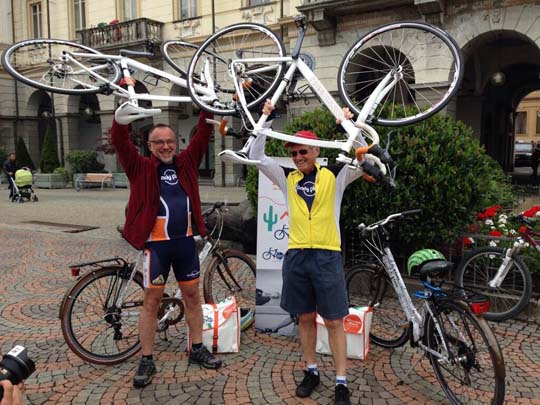 ▲ Angelo Pittro – EDT Torino, they publish Lonely Planet guidebooks in Italy – and me with bicycles in Aosta, Italy
But profession, philanthropy and everything else apart the simple fact is that I love to travel. I love to see new places, to discover the history, the artefacts, the culture, the back story behind so much of our world. I’ve often said that my favourite place in the world is the departure lounge, because then I know I’m on my way somewhere. Although equally my favourite means of transport are still my own two feet or a bicycle.


