Latest Posts:
Cocos Keeling Islands – a colonial hangover?
Thursday, 2 April 2026
Having ticked off Christmas Island I continued another hour’s flight west across the Indian Ocean (and another 30 minutes time change) to the Cocos Keeling Islands, 1000km away. There are 27 islands around the Cocos Keeling Atoll, but only two of them are inhabited. West Island has the airport, most of the tourist facilities and a population of 150. Across the lagoon Home Island has the Malay population who used to harvest the coconuts to process as copra for the Clunies-Ross family. Today there are about 450 people on Home Island.
The Cocos Keeling Islands have had a decidedly colourful history, check Wikipedia for the full story. In the late 1820s to early 1830s Alexander Hare and John Clunies-Ross turned up on the uninhabited islands, Hare with a ‘large, multi-ethnic harem of [enslaved] women.’ The Clunies-Ross family ended up in control and stayed that way until after WW II although Charles Darwin on HMS Beagle also dropped by in 1836 to work on his theories on coral reef development. The islands were effectively a little feudal slice of the British Empire, managed by the family, sustained by coconut plantations and worked by Malays. Singapore briefly took control, then it went back to Britain before Australia took over from 1955, although effectively the Clunies-Ross family ran it the whole time. In the 1970s the Australian government began to be embarrassed about running a little hangover from the British Empire and by 1983 the family had been eased out, the Malay population had opted for Australian citizenship rather than returning to Malaysia, the copra business had faded away and that’s Cocos Keeling today: a little bit of tourism, the possibility of enlarging the airport to become a military base (Diega Garcia Mark 2?), but most of the population is on Australian ‘benefits,’ ie the dole. John Clunies-Ross still lives on West Island.
In 2017 Chemical Media, the Australian documentary film producer I’m involved with, made Australia’s Forgotten Islands an SBS production about the islands and the end of the Clunies-Ross ‘rule.’
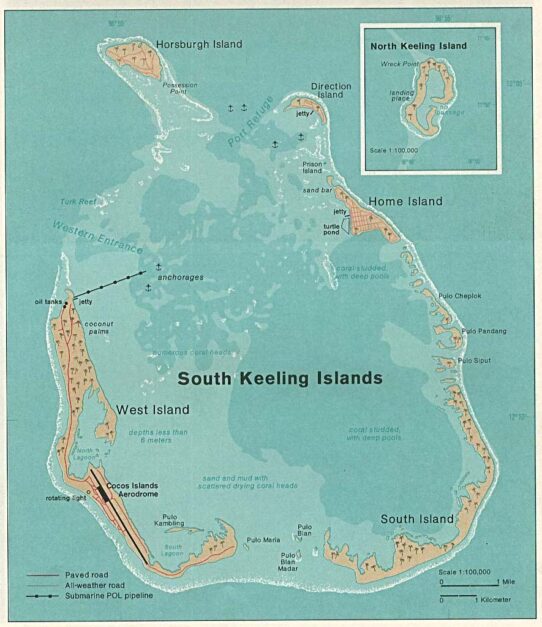 ▲ Cocos Keeling Islands – map from Perry-Castañeda Library
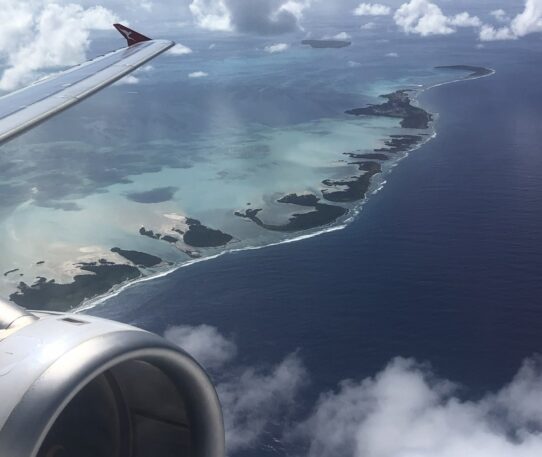 ▲ Departing Cocos Keeling – from left to right South Island, Home Island, Direction Island and Horsburgh Island. The water between the islands is so shallow it’s possible to walk along the island edge all the way from Home Island to the western end of South Island. Nearly all the tourist story is on West Island, within a few minutes walk of the airport terminal. That includes the tourist office, accommodation, restaurants, the supermarket and transport.
Where to Stay, Eat, Drink & Find Wheels
I stayed at The Breakers (tel +61 8 9162 77110) or cross the road to Cocos Castaway (tel +61 8 9162 6515) ‘just a coconut throw from the ocean.’ The Cocos Club is the place to head for a cold beer and blackboards outside announce restaurant opening hours. Which usually means Salty’s Bakery & Grill, between the airport arrival and departure doors or Surfer Girl Restaurant which has the best food on the islands. If you need wheels head to Cocos Autos, they have the biggest fleet although they can be totally booked out. Alternatively try Happy Jacks or rent an electric bicycle. Remember the local bus service is just 50c.
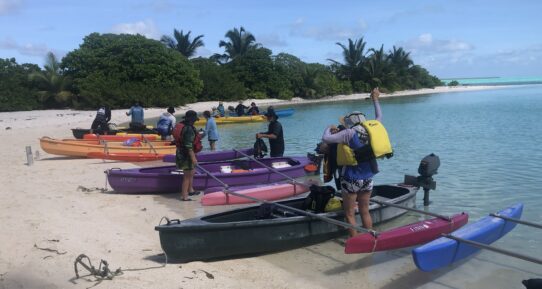 ▲ One of the highlights of a Cocos Keeling visit is the outrigger motor canoe trip, you assemble at the eastern end of West Island and start with snorkelling the rip beside Pulu Maria. Then, propelled by your outrigger’s little 2.5hp Yamaha outboard, you cross towards the western end of South Island, making landings on Pulu Blan Madar and Pulu Blan. On these two islands blue-tailed skinks were introduced from the reptile project on Christmas Island after they became extinct there. There are lots of big hermit crabs on Pulu Blan so we organize a hermit crab race, as you do. My crab, named Phar Lhap, was a loser, it didn’t even wake up and think about moving until the winners were well past the outer circle.
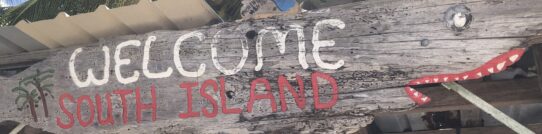 ▲ We also made a landing on the western end of South Island, before heading back to our starting point.
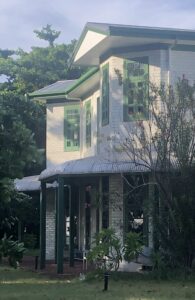 ◄ Oceania House, at one time the Clunies-Ross family home, is Home Island’s major attraction. Today it operates as a hotel, but there are tours of the fine old wooden house once a week. Queen Elizabeth II stayed here in 1954. Home Island also has an interesting museum with some Clunies-Ross history and a collection of boats from their era. An adjacent building restores traditional old jukongs, the wooden island boats. Overall, however, I found Home Island rather disappointing, it’s clearly been totally constructed with bland and uniform Australian government housing, don’t expect a colourful Malay village although there is a supermarket, a mosque and a couple of places to eat. The ferry between West Island and Home Island takes about half an hour and costs just A$2.50. You can get from the West Island settlement, clustered around the airport building, to the ferry jetty at Rumah Baru on the bus service for 50c.
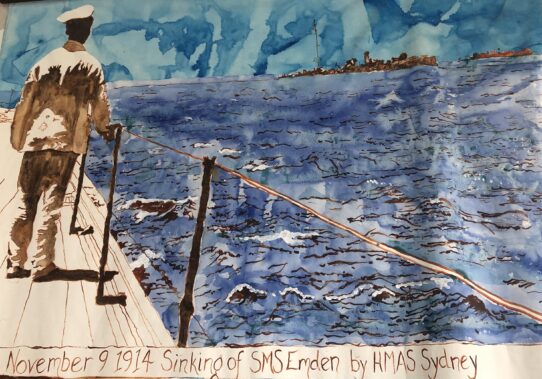 ▲ The sinking of the German cruiser SMS Emden by HMAS Sydney in 1914 was the major WW I event for the Cocos Keeling Islands. The naval encounter saw the crippled Emden run on to the reef at North Keeling Island, about 20km north of the main Cocos Keeling Atoll. There is very little to be seen of the wreck today, most of it was salvaged by a Japanese company in the 1950s. There are, however, a number of Emden memorials and on Direction Island there’s a rotunda with a detailed story of the Sydney-Emden encounter. In WW II another Australia-German naval encounter took place off the Western Australian coast, this time between a later HMAS Sydney and the German raider Kormoran. Both vessels sank, but the Sydney went down with all hands. There was not a single survivor from the 645 crew.
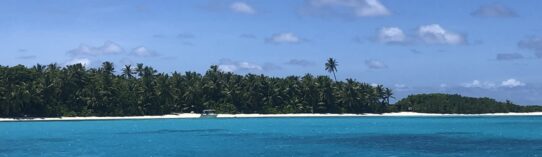 ▲ You couldn’t ask for a finer beach than the one along the south coast of Direction Island and at the eastern end of the island a fast-flowing rip gives you a free ride, snorkelling over the reef. On Thursdays the ferry service runs from West Island and Home Island across to Direction Island and drops you off to explore the island before collecting you again mid-afternoon. And all for the standard ferry fare of A$2.50.
For more exploration you can charter a whaler to take you across to Direction Island from Penelope Yorke (penne.yorke@yahoo.com) – I landed on Prison Island, which is more like Prison Sandbar although once upon a time it had, supposedly, trees and a house where, supposedly again, Alexander Hare kept his harem, he could walk there from Home Island. Like the rip off the eastern end of Direction Island there’s also a handy rip for snorkelling from the western end of Prison Island. Lots of colourful little fish and a few black tip reef sharks, I’d be disappointed if I didn’t see a few of them. Beyond the Direction Island rip there’s a bommie which acts as a cleaning station for manta rays. You’ll often encounter the magnificent mantas swirling back and forth across the bommie, accompanied by cleaner fish.
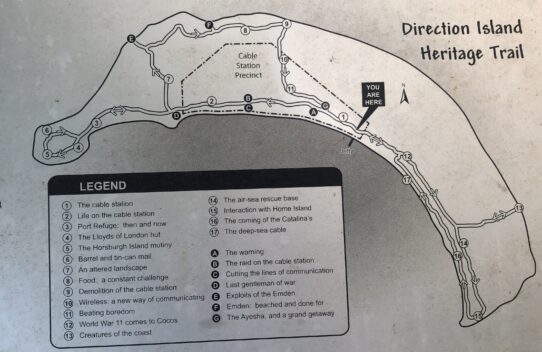 ▲ It can take a couple of hours to walk the three km history trail around Direction Island, a bit longer if you walk right along the seaward side of the island. That’s rocky and takes you by lots (and I do mean lots) of plastic flotsam plus quite a few bits of crumbling cable station foundations, brickwork and metal machinery. The history trail is somewhat difficult to follow at times, I bet very few visitors get to the final handful of panels at the western end of the island. On the beach there are lots of hermit crabs as well. As well as the cable station history there is more on the island’s WW II history when Catalina flying boats used to land here.
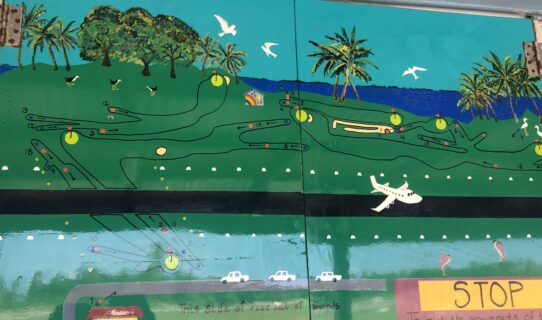 ▲ A round of golf is definitely a West Island ‘must do’ since two of the holes play across the runway. Well there are only two flights a week. Join the island golfers for Thursday’s ‘Scroungers’ round at 330pm. Cocos golfing dress standards? Some of the players will be barefoot.
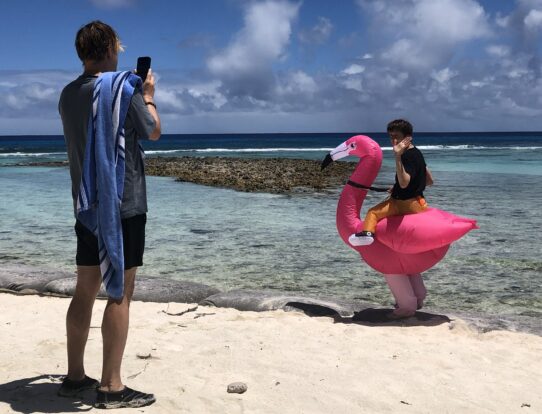 ▲ Finally who comes to the Cocos Keeling Islands with an inflatable flamingo outfit? They had to be influencers.