Christmas Island – Red Crab Territory
Sunday, 29 March 2026There are a number of Christmas Islands around the world, this one is an Australian territory technically part of Western Australia with a population of about 1700. Straight line it’s only 500km south of Jakarta, the capital of Indonesia, but the only flights to Christmas Island are the twice weekly connection from Perth with Qantas Link, a 3 hour 40 minute flight north. It’s also connected twice a week with the Cocos Keeling Islands, another Australia territory 1000km further west, and the subject of my next blog.
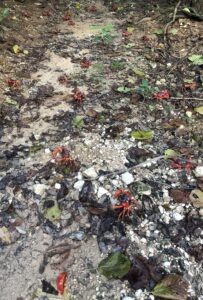 ◄ The big Christmas Island attraction? The annual red crab migration when millions of red crabs emerge from the forest and head down to the coast to mate. This amazing event takes place on the full moon night in November-December each year right after the wet season kicks in. You can’t count on it, if the wet season fails to commence the crabs may decide to put things off until the next full moon. But the island’s tourist population, there are rooms enough to accommodate 120 to 150 tourists normally, certainly booms at crab migration time.
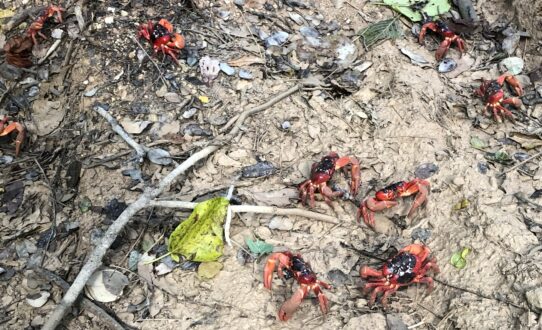
 ▲ The migration event may be the big story, but if you want crabs Christmas Island has plenty of them at any time of year. Tens of thousands if not millions. Honestly I have never seen so many crabs in my life.
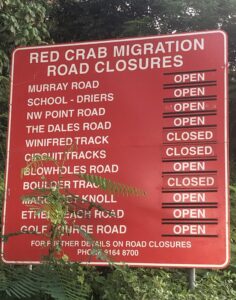
◄ At migration time roads can be closed to protect the crabs. The island’s road trains, huge trucks transporting super phosphate down to the loading docks at Flying Fish Cove at Township can wipe out huge numbers of crabs.
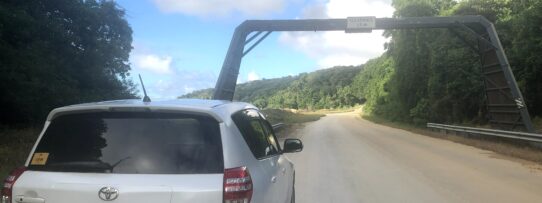 ▲ There is a crab bridge across Murray Rd, just west of Township, to provide a safe passage across the highway. Yes the ascents and descent look impossibly steep, but the crabs have no trouble using them. In many other places grids indicate where there are crab tunnels below the road, the migrating crabs are funnelled down towards the safe crossing point.
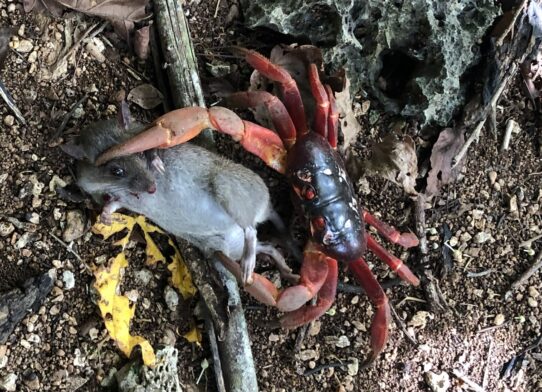 ▲ What do red crabs live on? Essentially they’re vegetarian, but I did encounter this red crab carrying a dead mouse off for lunch. Yes, it was definitely dead although I have no idea what killed it.
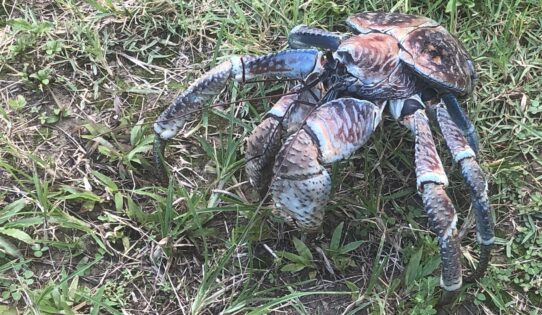 ▲ Robber crab
 Red crabs make up the big population, but there are no shortage of other crabs including tiny hermit crabs, often found close to the beach, blue crabs and the hulking robber crabs. Also known as coconut crabs – yes they can open coconuts – robber crabs will eat anything including other crabs. Your bins are always of interest, well they are called robbers.
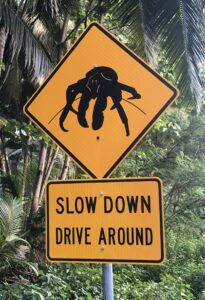
◄ Signs warn you to drive around robber crabs, some of the signs add that you should not drive over them even if you’re in a 4WD. Presumably if you drive over them they will take offense, rip your car door open and haul you out to be dismembered. They are big crabs and you should drive around their front as they tend to walk backwards in defence.
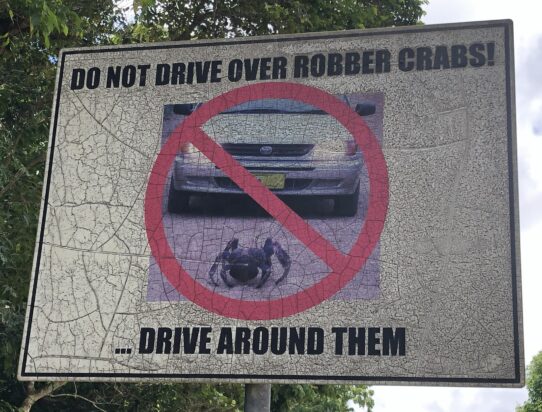
 ▲ Caution with robber crabs.
◄ You would certainly not call Christmas Island ‘busy.’ This was typically heavy traffic on the North South Baseline Road past the airport. Sometimes I would drive 10 or 20 km, do an hour or so walk and get back to my place in Settlement after hardly seeing anybody else – on feet or wheels.
Christmas Islanders are all concentrated in Township at the north-east corner of the island, eight km from the airport. Township is subdivided into Settlement, Kampong, Silver City, Poon Saan and Drumsite. Tourists are almost all in Settlement.
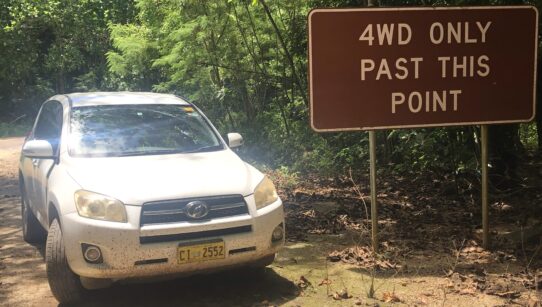 ▲ Get off the main roads and you’ll soon need four-wheel drive. This is the road to Greta Beach and Dolly Beach. Like most Christmas Island visitors I rented a Toyota Rav4 and it got me everywhere I needed to go without any problems, good road or bad. There are no taxis or buses on Christmas Island so even getting from the airport to your accommodation requires either a pre-arranged pick up or a rent-a-car.
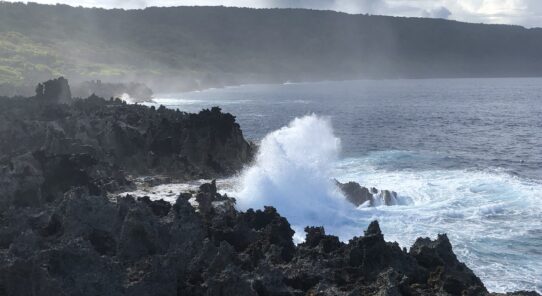 ▲ There’s lots to see around Christmas Island and lots of excellent walks, most of them fairly short, like the stroll to the spectacular Blowholes.
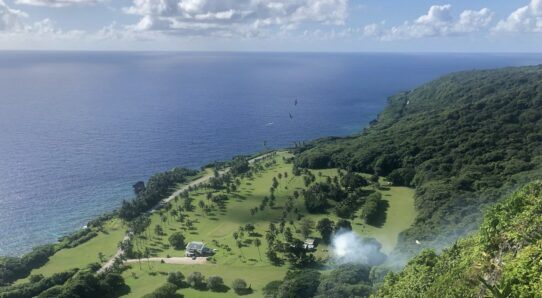 ▲ From Quarry Rd between the airport and Township, the one population centre on the island, there’s an excellent walk to Golf Course Lookout, gazing down at the pretty golf course. Which could also be one of the cheaper rounds of golf to enjoy in Australia. From up at the lookout you are often looking down at frigate birds.
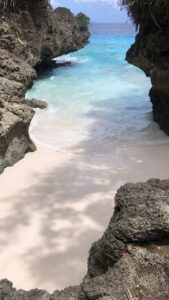 ◄ A number of the walks lead to beaches, like pretty little Merrial Beach, but don’t go there except at lower tide. The waves can wash right up to the top of the little inlet. Flying Fish Cove, right beside Kampong the Malay quarter and main jetty in the centre of Township has a popular beach and excellent snorkelling alongside the reef running out parallel to the jetty. I met up with some friendly white tip reef sharks when I went snorkelling there. I also went scuba diving with Hama at Diving Christmas Island or Wet’n’Dry Adventures. Good diving!
Just beyond Flying Fish Cove is Tai Jin House, the old colonial era residence of the British administrator. Upstairs there’s an excellent little museum although it desperately needs some sort of signboard downstairs to alert you to its presence.
 ▲ Christmas Island National Park occupies 85 square km of the island’s total 135 square km area, so quite a substantial part of the island. Superphosphate mining is still the island’s big economic activity although, fortunately, the island is far from being the environmental disaster zone that Nauru, off to the other side of Australia, has become. Superphosphate mining on Nauru has simply stripped the island bare.
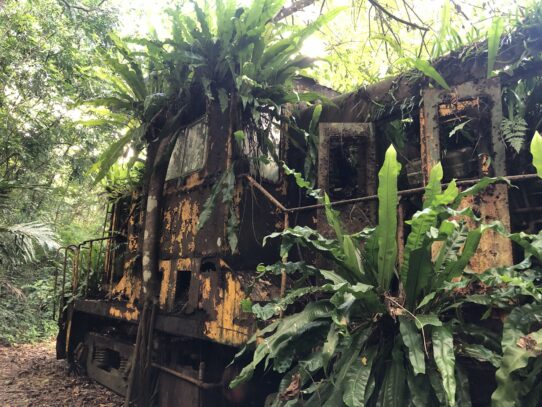 ▲ Whitcomb Locomotive #890, disappearing back to the jungle beside the crab bridge outside Township, is a reminder that superphosphate was once hauled across the island on a railway line, now road trains do the work. It wasn’t only fertiliser that the trains carried. Once upon a time South Point was a thriving little settlement and each day school children would take the train across the island to their school at Drumsite in Township. The West Point buildings – presumably including the five brothels it featured in its heyday – were demolished in 1977 and the railway line across the island was torn up and sold as scrap.
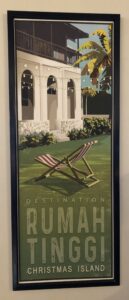 ◄ Rumah Tinggi – Christmas Island does not have many tourists and there are not many places for them to eat. Directly overlooking the sea in Settlement this is the island’s best place for a meal and a sunset drink. Except it’s only open four days a week. It was extremely handy for Villa Papaya, the very pleasant little Balinese-inspired villa where I stayed.
Other eating possibilities include the Chinese Le Cla Café in Settlement across from the island supermarket and beside the tourist office. Or Lucky Ho up at Poon San, above the outdoor cinema which shows films once a week (I dropped in for Song Sung Blue, seats are A$5). You’ll also find Meng Chong Trading up at Poon San, if you want fresh fruit or vegetables this is the place to come. Finally there’s Tracks Tavern, the island pub. But check the opening days and hours before setting out for any of these places.
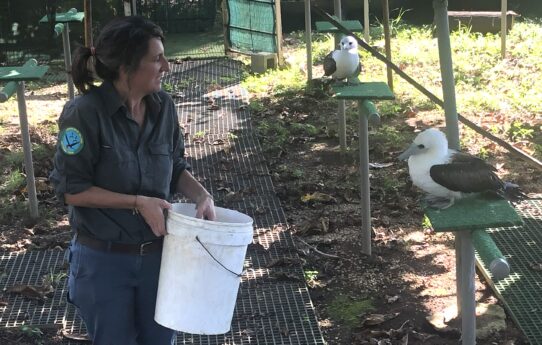 ▲ Chrissy feeding an endangered Abbot’s booby at the Christmas Island National Park Seabird Rehabilitation Facility. That it’s endangered is scarcely surprising since they are almost only found on Christmas Island, breed very slowly and then take a long time to raise, their parents must feed them for eight months? And if a baby booby falls out of its nest at the top of a lofty rainforest tree it ain’t climbing back up again? When they do depart the nest it’s a once only decision, hop out of the nest and fly, there are no second practice attempts. It is, however, a very large and handsome bird.
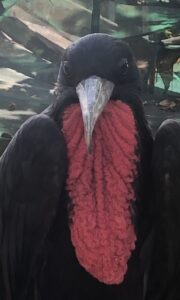 ◄ Frigate birds, almost the signature bird of Christmas Island, also seem to hang around the facility even though they don’t (usually) get fed. This handsome male is sporting the bright red gular pouch which they inflate during the mating season to impress female frigate birds. Twitchers – very enthusiastic bird watchers – were getting excited about Christmas Island while I was there, because an Indian pond heron – anonymous little beige thing, but previously unseen in Australia – had turned up and was hanging around the Dive Villa place in Settlement.
The Territory Day Park also features a fine circular nature trail walking track. During my week on Christmas Island I hit almost every walking trail on the island including the ‘hard’ descent to West White Beach. A stretch shimmies down a cliff face using a rope.
The walks are much shorter and easier to the excellent lookouts at Martin Point and Margaret Knoll – now that’s a really fancy lookout point. And don’t miss the Hugh’s Dale Waterfall Walk.
There are lots of warnings about the island walks. Although the walking trails are generally well marked if you got off the trail it would be very easy to get seriously lost and there’s no mobile phone reception across much of the island. If you’re planning a lot of walking and you’re by yourself consider the offer to borrow or hire an EPIRB – a Personal Locator Beacon (PLB) – from the police station in Settlement.
Compromised birds are looked after at the facility in Township and reptiles are cared for at the Pink House, in the centre of the island. For assorted reasons the island’s endemic tiny blue-tailed skinks had become extinct in the wild by 2010. Fortunately at the Pink House and at Taronga Conservation Society Australia in Sydney captive populations were successfully bred until they numbered 1500 happy little lizards. From 2019 populations of blue-tailed skinks were successfully established on two tiny rat-free islands in the Cocos Keeling group. See my next blog.
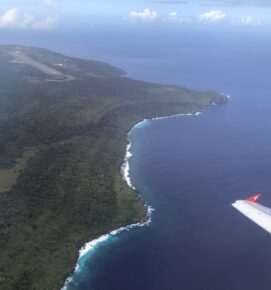 ◄ And finally I flew out of Christmas Island, heading to the Cocos Keeling Islands. Incidentally both Christmas Island and Cocos Keeling Island feature in my favourite travel inspiration book Pocket Atlas of Remote Islands by Judith Shalansky. She subtitles it ‘’Fifty Islands I have not visited and never will.’ I’d already put ticks beside six of her remote island – Rapa Iti (in the Austral group of French Polynesia), Robinson Crusoe Island (off Chile), Easter Island (even further off Chile), Pitcairn Island (keep travelling west), Norfolk Island (between Australia and New Zealand) and Deception Island (Antarctica).
So now my remote island score is up to eight. If you’ve reached double figures you’re definitely a serious traveller.
Apart from superphosphate mining (but how long will it go on for?) and crab watching there have been a couple of other activities on Christmas Island. From 1993 to 1998 the 156 room Christmas Island Casino Resort attracted – very successfully – high rollers from Malaysia, Indonesia and Singapore, all that Chinese money which needed to be laundered. Of course those governments weren’t very happy about this nearby overseas casino and nor, for that matter, were Australia’s mainland casino kings. So it was doomed and has been closed and shuttered for nearly 30 years. It’s worth noting that the resort probably had more tourist rooms than the entire island has today. I’d make money out of it, I’d charge today’s visitors A$10 for a quick tour.
Briefly Christmas Island was also a refugee centre. Why sail all the way to the Australian mainland – and then get shipped off to Australia’s refugee prison camp on Nauru – if you could land at handy Christmas Island? The Australian government killed that idea by announcing that Christmas Island was no longer part of Australia from a refugee perspective. Despite which some refugees continued to arrive and camps were built to house them until they could be shipped out. In 2010 a ship with 92 passengers from Iran and Iraq and crew arrived at the island, failed to make it in to Flying Fish Cove and crashed against the shore at Rocky Point in Settlement. It went down, drowning 50 of those on board.


